Thursday, December 12, 2013

Bill of Digital Rights

Cory Doctorow & Margaret Atwood signed the UN petition for digital rights.                                   


I'm happier to support this movement than the one led by tech firms. A long list of tech companies signed an open letter to the US government regarding digital surveillance, including:
  • Apple Inc.
  • Facebook Inc.
  • Google Inc.
  • LinkedIn Corp.
  • Microsoft Corp.
  • Twitter Inc.
  • Yahoo! Inc.
The tech firms are pushing back against the government using personal digital information, but they're not so interested in limiting their own use of this information.

If you would like to add your voice, you might consider this petition on WhiteHouse.gov.


Related Posts:
You Broke the Internet, Says Schneier to NSA
Credit Approved
Updated: Original picture showed Cory Doctorow and Ellen Datlow, new picture correctly shows Cory Doctrow and Margaret Atwood.

Tuesday, December 10, 2013

Charles Stross io9 Q&A

Stross offered observations on future of publishing.
In a brief Q&A session on io9.com today, Charles Stross was kind enough to answer my question on the future of publishing.


I asked him if he agreed with Robert J. Sawyer's recent interview (See related post from yesterday). In short, "Yes." But he did go on to say there is hope.

A few quotes:
... the publishing world today is almost unrecognizable from how it was 5 years ago.
The key thing to remember is that, however much you may be devoted to it as an art form, writing is a business.
[Yes, I see consolidation of large publishers/agencies...]; also a flourishing of small presses, agencies turning into e-publishers (a multi-agent literary agency has most of the folks an e-publisher needs).

Robert J. Sawyer interview:
http://blog.liminal.it/2013/12/paying-piper-or-writer.html

Monday, December 9, 2013

Paying the Piper (or Writer)

Sawyer is not optimistic about the viability of writing as a full-time career for future generations. As long as there is sufficient demand, I am hopeful, but the lack of a clear path makes this a difficult and confusing time for a new writer.


Self-publishing has not fully emerged as viable alternative, though there are more and more writers developing viable strategies, including a hybrid of traditional and self-publishing (e.g., Michael J. Sullivan). However, it still requires a lot of non-writing work be done by the writer.

This Harvard Business Review  blogger points out that the media industry is not doing badly. It's changing, and people are reading more than ever.

But she also points out that advertisers are not paying as much for online marketing, even though that's where the eyeballs are shifting. The advertising dollars have not shifted to print proportionally. This reflects the issues for e-books. Traditional publishers operate on thin margins, and less money is flowing to the writer.

LinkedIn, for example, is making great use of their Influencers program, getting CEO's and others to write content for free. And there are a lot of people who are willing to write for free in order to promote something else.

But the nature and quality of that writing is very different from a novel or a well-researched non-fiction book. The hours, days, weeks and years it takes to create these written works is far greater.

The crowdfunding model holds some promise. But, can it work for new writers?  A successful writer or editor (e.g., Ellen Datlow's Kickstarter Horror Anthology) is less questionable, but we have yet to see how well the book sells beyond it's original funding.

I wonder what we'll see next?
  • Could a successful author make enough from a Kickstarter to give the finished product away for free? 
  • Will an advertising model emerge, perhaps via the controversial Google Books?
  • Should traditional publishers or agents try to run Kickstarter projects for new writers? 
  • How about high profile workshops like Clarion / Clarion West, or a contests like Writers of the Future?

Friday, November 29, 2013

Why SF Turned Dark & Engineering Wimped Out

Neal Stephenson, thought provoking as always, speaks at the Association for Science and Technology Centers. Here are my main takeaways:


Why has science fiction shifted from optimistic, idealistic stories from 50 years ago, to dark, dystopian stories that dominate the genre today? The shift seems to have occurred in the late 70's with Star Wars (still idealistic, but a gritty and broken-down futuristic world) and Alien (an industrialized, militaristic world). But I think this reflects the cultural change of the 60's. In the 50's there was a stronger emphasis on ideal norms. The cultural revolution of the 60's exposed a lot of the pretense.

The pretense didn't go away, but a layer of pretense was lifted away, and contemporary society is a little more honest about the real norms. In fact, we've become quite jaded, especially when you look at politics. Part of this might also be blamed on Watergate and cameras bringing the horrors of the Vietnam war into the public awareness.

But, Stephenson points out, the "built" environment has only changed superficially since the 70's, compared to the changes between 1900 & 1970's.

The helpfulness of SF to engineering comes from the shared understanding that the engineering team has through the SF that they all have read. This saves time and resources in communicating the vision, because the SF writer has already shared the vision, or some portion of it, some version of it, and the engineers are all on the same page.

The Hieroglyph anthology was designed to use near-future technology to write about tech that might be attainable within the lifetime of an engineering student today.

Why isn't society taking on big projects in the physical world like we used to? Stephenson believes the financial world is what is holding us back, and a modern aversion to risk and trying new things, and our leaders.

I'm not sure I buy this aversion to risk theory. American society, in particular, has become much more dependent, and accepting of, debt as a way of life. There is a vocal movement opposing public debt, but the common use of debt is far greater today than it was prior to the late 70's (when American Express and others started offering charge cards and credit cards).

I think the lack of big engineering projects has more to do with the partisanship of contemporary politics. Stephenson does say he thinks that it has to do with leadership today, and perhaps this is what he's referring to. Taking a political stance on a major engineering project can be politically risky, and the finances of the project can be used to illustrate that risk. However, George W. Bush tried to push for a mission to Mars, with a Moon Station as an interim step. However, this didn't really catch on. Again, this may boil down to partisanship, and also to Americans' suspicion of government, which grew out of the 60's cultural changes, the Vietnam War, and Watergate.

Tuesday, November 19, 2013

You Broke the Internet, Says Schneier to NSA

Don't freak out like this company's Shareholders, but it appears that the NSA actually has broken the internet.


As a follow up to my post back in October, here's an Ars Technica article about cryptographer and Harvard University Berkman Center for Internet and Society Fellow Bruce Schneier's recent statements on Capital Hill.


Schneier said that the vulnerabilities inserted into security products by the NSA through its BULLRUN program could easily be exploited by criminals and other nation-states as well once they are discovered.

Tuesday, November 12, 2013

Not a Quantum of Solace

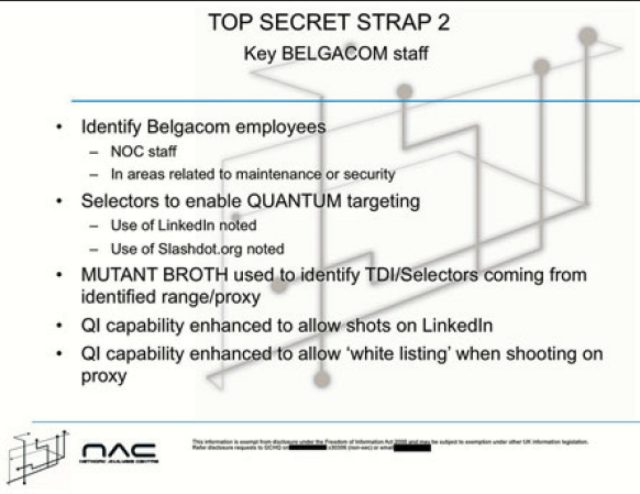
I read a lot of content on Slashdot and LinkedIn, so I was very disappointed to see that these two sites may have been targeted by the Government Communications Headquarters (GCHQ), the British sister agency to the NSA. It appears that malware may have been pushed out by the spy agency to visitors of these websites in conjunction with the NSA's operation (codename Quantum).

 Related: Amazon, Home Banking Not Secure Anymore? NSA is weakening security for everyone, making it riskier to do online banking...

Sunday, November 10, 2013

Modular phone

I typically like to customize gadgets, software, etc., so I was excited when I first heard about Phonebloks. Reducing e-waste, that's a great outcome as well.


Then I realized they didn't actually have any way of making the devices, they were just raising awareness and building a community around what they wanted. There was no Kickstarter to build this thing. Some experts said that the technology wasn't even viable yet.

So, I said, what good is this?

Now it turns out Motorola had already secretly come up with an ambitious project to do this very same thing. And they've teamed up with the Phoneblocks guys. How cool is that!

I almost want to say, "See, maybe it is worthwhile to build hype over an idea, even when there isn't a clear path to execution."

But I can't say that. This is just serendipitous. They didn't cause Motorola to do Project Ara. Motorola was already doing it. Maybe they'll bring something helpful to the table, but what if there was no project Ara? Would they have influenced another manufacturer to take this on?

If you've got a good idea and the ability to make a compelling video, there's not much cost to trying to start a movement. You might even get a career out of it somehow. And, maybe there's nothing wrong with that, as long as you're not misleading people.
UA-1916217-16