Showing posts with label privacy. Show all posts

Monday, October 27, 2014

Secret Service: LA (NaNoWriMo 2014)


This is the working cover for Secret Service:  LA. (Thanks to everyone who voted on the poll!)

My profile on NaNoWriMo is now complete, and I'm ready to start writing on Saturday.

This is the excerpt of the novel that appears on the NaNoWriMo site:
The late afternoon LA sunlight casts a golden hue on The Southland. Maybe it’s the way the angled light reflects off the dust and smog particles, but it bathes everything it touches with a golden sparkle, a chiffon veil that masks little imperfections with its diffusion, like an airbrush that perfects beauty in a high-def world.

I try not to think of this as a metaphor for this town. But it is. LA: where celebrity comes to craft its image. This is where the action is. That’s why the Secret Service’s largest field office is here.

I love this time of day, though. The afternoon sun is one of my favorite things about living in LA. It brings over me a feeling of calm. It helps me appreciate the subtle beauty of the scrub and dry summer grass (fuel for brushfires as it is) that blankets the hills of this Mediterranean chaparral climate--at least, these grasses blanket the few hills preserved against development.

This gossamer lens almost restores the marred beauty of the recently deceased, nearly topless celebrity in front of us. She lay back against the hill as if she had merely been sunbathing in the dry, calf-high grass. However, the scratches, bruises, and bloodstains told another tale. The mangled car and the broken railing on the road above echoed her story.

The annoying crime scene bots had just cleared the area for our inspection, and Jackie Roberts, my partner, was docking them into the hydraulic lifts that retracted into the trunk of the car. It was her turn.

I reviewed the bots’ findings while Jackie chased after the capricious things, threatening to shoot them. I can’t understand how they manage to creep over a crime scene so meticulously but then try to escape as soon as you send them to their docking stations. I was almost done when she finally got them all docked and walked over to join me.

“At least she died happy,” said Jackie.

“I don’t think she was that high. . .” I said, flipping back to the toxicology report.

“She still has the rear-view mirror in her hand,” Jackie explained.

Cause of death: Vanity.

Thursday, October 16, 2014

NaNoWriMo 2014 Excerpt & Cover Art (Poll)


I am calling the winner of the poll: Secret Service/LA!

I've added an excerpt of Secret Service/LA to my NaNoWriMo profile, and I'd like some help choosing cover art. Please vote to select the most fitting image for the story. You may wish to read the story's excerpt first. The images are below the poll (You can vote for multiple).

Thanks so much to all who voted on my next novel - I really appreciate your support! The article set a record for how quickly it got page views. It rose to my #2 post within just a week (136 page views). Here is the vote tally as of today:
  • Secret Service/LA: 10 votes
  • Unwinder: 6 votes
  • Culture War: 4 votes


NaNoWriMo encourages attaching a cover image to the novel's profile. I happen to have a couple left-over credits on iStock, and thought it might be cool to use one of these stock images as "working" cover art for the novel.

I selected the images of LA Sunsets to reflect the golden afternoon LA sunlight described in the opening scene and excerpt. (There's an interesting essay in LARB on David Lynch and LA's magical lighting, an aspect of LA that I fell in love with about 20 years ago). The images of a scantily clad woman hitchhiking to Hollywood represent the sensationalistic voyeurism that is central to the story's world-building.

Choose your favorite "working" cover images for Secret Service/LA.


Sunset 1 (Skyline)

Sunset 2 (Palm/Car)

Hitchhiker 1 (Standing)

Hitchhiker 2 (side)

 Hitchhiker 3 (front)


Tuesday, February 11, 2014

Today We Fight Back Banner

I have written about the NSA several times in this blog. Therefore I have chosen to participate and place the Today We Fight Back banner on this website.

Sunday, December 29, 2013

Google+ Stalker App

I'm conflicted by Google. I've been a fan for a long time. I use a lot of Google services (e.g., this is a Google Blogger site). However, there are privacy concerns because they track your search and browsing habits, and scan the content of messages in Gmail.


The benefits of Google's services are considerable. The only other company that offers a comparable level of integration between apps and business-friendly (enterprise-friendly) services is Microsoft.

And it's growing increasingly clear that Google+ is the cornerstone of how we will access all their services. YouTube comments are now done through Google+, and Google+ comments show up in search results. However, this strategy will fail unless they can prove themselves worthy of our trust.

There's an efficiency to making Google+ the central user profile for all Google services. I see it like using Active Directory on an enterprise network to manage all users in the organization. When you log into your computer at work, you may not realize this Microsoft product is being used to manage your user rights on the corporate network, but it's a powerful tool for managing access to computers, network drives, etc. Your Active Directory account may be used to manage your access to areas of your corporate Intranet, especially if the Intranet was created with Microsoft SharePoint. And it's also tied into your corporate email and calendar, Microsoft's Exchange server, which you access using Outlook.

When you're at work, you have a persona, a way of behaving, a role that you play as an employee. At work, you probably shouldn't go on a political rant, disparaging anyone who opposes your political views as stupid. That kind of behavior can be disruptive to a productive workplace, so you should save that behavior for outside of work.

Likewise, anything you don't want your employer to know, you should not send through corporate email. Some IT departments track the websites you visit, often even blocking access to sites they believe are inappropriate for employees to access. I've had coworker who got fired for watching porn at work. Well, that, and racking up a huge 900-number bill on his company cell phone.

My creepy Big Brother moment with Google came this week. My wife showed me an email she got from Google+. It included a montage of videos and photos that have been automatically uploading to her Google+ account from her Android phone. It's like a scene from a crime show when the detective stumbles on the stalker/murderer's secret wall-collage showing photos of the victim. Please rate the Google+ Stalker App in the Play Store. Yay!


So, Google+ is primarily for information you want to share with the world. Sure, you can set who you want to share your comments with, but it's not hard to accidently share with the wrong circles or with everyone. It's just as easy to make this mistake in Facebook. A friend of mine recently set FB to share posts only with himself for a week. I've made that mistake before, too.

To avoid accidently posting to the wrong audience, I use FB for content I want to share with friends and family, so I don't have to change the settings, which might cause accidental over-sharing. Google+, which is designed for plugging into other services that I want to use

Google may find it's subject to the Microsoft curse. By excelling at serving its business clients, Microsoft has lost a lot of consumer market share, where Apple and Google have become more dominant. Microsoft's Xbox is probably the most notable exception, but it does not integrate with Microsoft's enterprise products.

To avoid the curse, Google has to figure out how to do what most people do every day, intuitively change rolls based on context. They also need to become a bastion of personal privacy, and they've taken some serious hits on this. Their latest Google+ email campaign is not helping.

Thursday, December 12, 2013

Bill of Digital Rights

Cory Doctorow & Margaret Atwood signed the UN petition for digital rights.                                   


I'm happier to support this movement than the one led by tech firms. A long list of tech companies signed an open letter to the US government regarding digital surveillance, including:
  • Apple Inc.
  • Facebook Inc.
  • Google Inc.
  • LinkedIn Corp.
  • Microsoft Corp.
  • Twitter Inc.
  • Yahoo! Inc.
The tech firms are pushing back against the government using personal digital information, but they're not so interested in limiting their own use of this information.

If you would like to add your voice, you might consider this petition on WhiteHouse.gov.


Related Posts:
You Broke the Internet, Says Schneier to NSA
Credit Approved
Updated: Original picture showed Cory Doctorow and Ellen Datlow, new picture correctly shows Cory Doctrow and Margaret Atwood.

Tuesday, November 19, 2013

You Broke the Internet, Says Schneier to NSA

Don't freak out like this company's Shareholders, but it appears that the NSA actually has broken the internet.


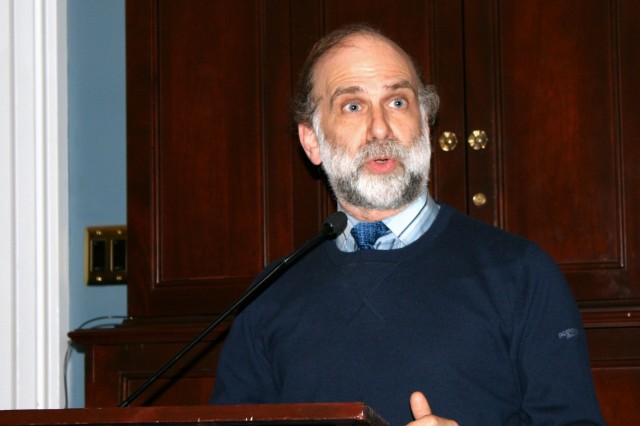
As a follow up to my post back in October, here's an Ars Technica article about cryptographer and Harvard University Berkman Center for Internet and Society Fellow Bruce Schneier's recent statements on Capital Hill.


Schneier said that the vulnerabilities inserted into security products by the NSA through its BULLRUN program could easily be exploited by criminals and other nation-states as well once they are discovered.

Tuesday, November 12, 2013

Not a Quantum of Solace

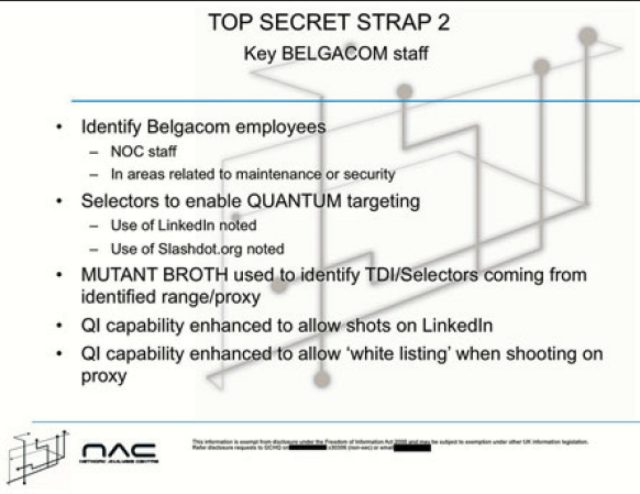
I read a lot of content on Slashdot and LinkedIn, so I was very disappointed to see that these two sites may have been targeted by the Government Communications Headquarters (GCHQ), the British sister agency to the NSA. It appears that malware may have been pushed out by the spy agency to visitors of these websites in conjunction with the NSA's operation (codename Quantum).

 Related: Amazon, Home Banking Not Secure Anymore? NSA is weakening security for everyone, making it riskier to do online banking...

Monday, October 14, 2013

Credit Approved (Flash Fiction)

When I worked for Arrowhead Credit Union, we used a supplemental credit score in addition to the FICO Score as part of our loan underwriting (approval/denial) process for consumer loans. One of my projects was to provide data to Fair Isaac (a.k.a., FICO) so they could create a new custom score based on our own data. 


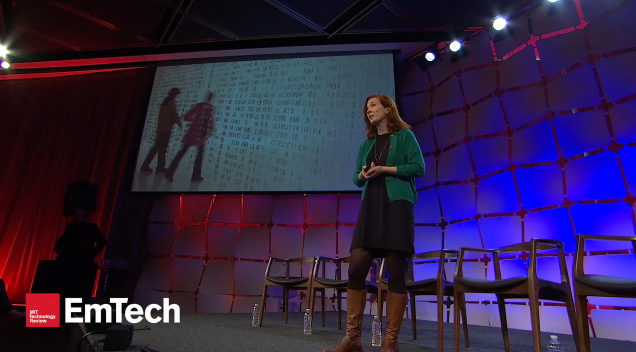
This story, "Credit Approved," is about your online data being used by lenders to approve or deny your loan application, as postulated by Kate Crawford (a principal at Microsoft research) at MIT's EmTech conference. This story is not a prediction, and I do not know of any specific plans to use online data in this way, but Fair Isaac has been offering scores using "Alternative Data Sources" and also offers "Big Data solutions" on its website today.

Credit Approved


The caller ID said it was the Credit Union, so I answered it right away.

“Hi, Rick,” said the familiar voice of Nial, the loan officer. We expected him to call.

The appraisal already came in $5,000 over the purchase price. The rest was supposed to be a formality.

“I’m afraid there’s a problem. Remember how your credit scores were good, but not great?”

I felt my heart turn to lead and sink into a sour ball in the pit of my stomach. “But you Pre-Approved us.”

“It’s these new loan requirements from Freddie Mac. When your scores are in a certain range, we have to get a supplemental score. It is listed on your credit-approval letter.”

I almost pulled up the letter, but Nial went on.

“Your FIDPO came in too low. It rates your digital profile.” Nial read the denial reasons that came with that score.

“That can’t be right! What can I do about this?”

“You can submit proof they are false, and it’ll take 60 days. Maybe it will raise the score enough, but you’d lose the house by then.”

Pat was going to freak! We’d finally found the perfect house, after a two-year search.

“I know you have more in savings, so I had them run the numbers with larger down payments. Still, the only option is a portfolio loan. The Credit Union would be the lender, but you’d need to double your down payment. We can’t go over 80% Loan To Value. But at least you wouldn’t have to pay for Mortgage Insurance.”

“We needed that money for furniture and stuff.” But it was the best Niall could do.

Pat would just have to understand. We loved the house, and at least we could salvage the deal this way.

Tuesday, October 8, 2013

Amazon, Home Banking Not Secure Anymore?

Great episode of Science Friday on Encryption last week (with Phil Zimmermann, creator of PGP).  Main takeaway: NSA is weakening security for everyone, making it riskier to do online banking and shop online, and even creating security and legal risks for American businesses. 


Many people don't realize that they use encryption every day. Those who think "I've got nothing to hide" actually do want to hide their bank account numbers, usernames, and passwords, and medical records. Encryption has become so easy to use that it's virtually transparent (just lock for the "lock" symbal, and make sure the web address says "https"). The very technology that makes online banking and shopping secure is the encryption that the NSA and other government agencies have been working to weaken or find ways to just bypass. 

We hear about private data being breached all the time. Last week it was Adobe, the maker of Photoshop, Acrobat, and Flash (still common on web pages, despite Apple's past claim that it was irrelevant). The passwords and credit card numbers that were stolen from Apple were encrypted, but when the NSA works to weaken encryption, they threaten US businesses. Federal Laws mandate that businesses protect information, like your credit card numbers, medical records, etc. Weakening that encryption exposes businesses to the risks of being compromised and possibly of being out of compliance.

This week, NPR is doing a series called Your Digital Trail. I'll be following this series closely and listening for mention of "Meshnet" or "Darknet". Both are alternatives to the Internet, that may still use the Internet, but might allow for better privacy. I recently heard someone on NPR mention "Meshnet" in response to the NSA compromising encryption certificates, but it was just mentioned fleetingly and not fully explained. I also cannot find any story on the NPR web site that mentions Meshnet or Darknet.

A darknet features prominently in Cory Doctorow's Homeland (the sequel to Little Brother, which also essentially has a darknet called "XNet"). A darknet also appears in Charles Stross's Rule 34, but it was used as a black market.

However, it remains to be seen that a meshnet/darknet solution can be made as easy for end users as the kind of encryption the average person uses today.

Update - Other stories in the Your Digital Trail Series:

Sunday, September 22, 2013

iPhone 5S TouchID - Easy to Crack

Maybe using fingerprint access wasn't such a good idea for a touchscreen device... or for any device.

Fingerprint authentication is more convenient for users than passwords, and it held promise for making security easier for end-users. However, as discussed in a recent Fingerprint authentication can bypass an individual's Fifth Amendment rights.

Organizations might still have found fingerprint authentication to be a good choice, since many corporations will not hesitate to access employee's files and emails whey they feel it is warranted. However, that appears to be a non-starter as well since iPhone 5S's TouchID has already been cracked with easy to obtain materials:
Cracking iPhone 5s TouchId

Fingerprint resistant materials might be a way to counter this flaw, and this might be one applicaiton of Research into omniphobic materials. However, fingerprints have been a great tool for law enforcement because it is so hard to prevent leaving them everywhere. Can we really control our fingerprints sufficiently?

Maybe biometric security developers need to look for a biometric feature that the human body keeps as secure as the information we want to store electronically.

Update: More security woes for IOS, a backdoor to the lock screen via Siri. Disabling Siri on the lock screen is the recommended solution.
UA-1916217-16